
The Art of Thinking About Thinking
Finding Your Inner Compass
MINDFULNESS - SOUNDSPIRITUAL AWARENESS
Nigel John Farmer
1/20/20264 min read
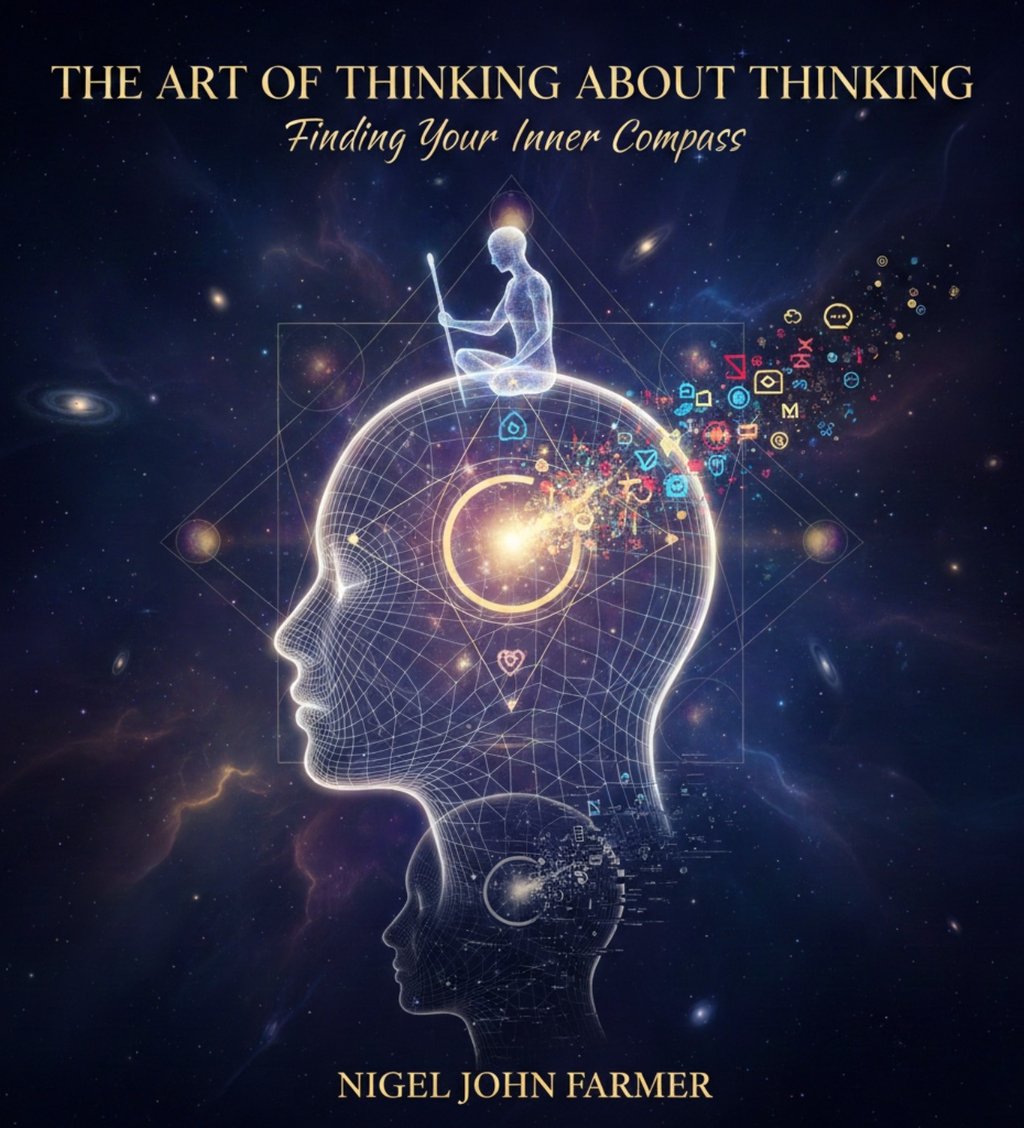
I have spent a great deal of my life exploring the boundaries of human consciousness, even experiencing phenomena like bi-location that challenge our conventional understanding of physics. Yet, despite these extraordinary experiences, I have found that the most vital tool we possess is actually quite simple. It is metacognition: the ability to notice and reflect on your own thinking.
It is that quiet part of the mind that can step back, take a breath, and ask: "What am I thinking right now, and why?" Instead of being completely caught inside thoughts or reactions, metacognition lets you observe them, question them, and most importantly, change them.
Stepping Outside the Stream
Most of us spend our days caught in a constant stream of consciousness. We have beliefs, biases, and reactions that feel like absolute truths. Metacognition allows us to step onto the riverbank and observe the water. Instead of being swept away by a strong reaction, we can observe it. We might notice that a sudden flash of irritation is not actually about the present moment, but is driven by a hidden fear.
This self observation is more than just a psychological trick; it is an energetic necessity. In my theory of the Interconnected Universe, I propose that thought is an active, non-material energy that shapes our reality. When we use metacognition to recognise emotional bias or realise a reaction is driven by fear rather than facts, we are essentially cleaning the signal we send out into the collective consciousness.
The Trinity of Mind in Essence
To truly understand how to use this thinking about thinking, we have to look at what I call the Mind in Essence. This is a profound trinity rooted in primordial geometry.
The heart provides intuitive knowing.
The brain handles cognitive processing.
The inner soul acts as the engine of the mind.
When we reflect on our thoughts, we are trying to bring these three into alignment. However, there is a delicate balance at play here:
Metacognition without purity becomes cleverness. If I am highly aware of how my mind works but lack a sense of moral or heart based purity, I simply become a better manipulator of my own reality. I can rationalise any behaviour or use psychological insights to win arguments rather than find truth. This is cleverness in its coldest, most fragmented form.
Purity without metacognition becomes blind zeal. We have all met those driven by intense, well meaning passion who lack any self awareness. Without the ability to question our own biases, we become rigid and closed to new possibilities. This contractive consciousness prevents us from accessing the deeper truths of the universe.
Achieving True Coherence
The magic happens in the middle. When we align metacognitive awareness with a sense of purity and honest intent, we produce coherence.
Coherence is expressed as a form of temporal harmonics, much like music. It is a state where the heart’s electromagnetic rhythm synchronises with the brain’s activity, opening a doorway to the universal conscious field. In this state, you are no longer fighting yourself. You are not just thinking about being better, and you are not blindly doing what you think is right. You are acting with a clear, observed, and honest purpose.
As the saying goes, coherence moves things. When you find this alignment, you gain a level of momentum that is impossible to achieve when you are fragmented. You become the master of your own mind rather than its servant.
To help you move from the theory into daily practice, here are some practical ways to cultivate metacognition. These exercises are designed to help you reclaim your attention and align your internal trinity.
1. The Five Minute Observation
Once a day, set a timer and simply watch your thoughts as if they were hybrid photonic waves passing through a field. Do not try to stop them or judge them. If a thought of worry arises, instead of entering the worry, say to yourself, "I am noticing a thought about worry." This creates the necessary distance to move from reactive conditioning to coherent awareness.
2. Identify the Polarity
When you feel a strong internal shift, ask yourself if the thought is expansive or contractive.
Love-based thoughts feel expansive and open you to new truths.
Fear-based thoughts feel contractive and close your awareness. By simply naming the polarity, you use the brain's cognitive processing to balance the heart's intuitive knowing.
3. Check Your Heart-Mind Coherence
Before making a significant decision, place your hand over your heart to focus your attention there. Breathe slowly and deeply, imagining your breath moving in and out of your heart centre. This physical act helps synchronise the heart's electromagnetic rhythm with your brain activity, allowing for clearer pattern recognition and intuition.
4. Audit Your Attention Streams
Practise "information hygiene" by noticing where your attention goes throughout the day. Our attention is a primary spiritual currency. If you find yourself caught in manufactured controversies or designed distractions, use that moment of realisation to consciously pivot your focus back to your own creative blueprint or imagination.
5. The "Why" Inquiry
When you catch yourself in a repetitive mental loop, ask, "What is the engine behind this thought?". Is it a fragment of old conditioning, or is it a coherent reflection of your Mind in Essence?. This helps dissolve mental schisms and brings the subconscious into conscious awareness.
Final Thoughts
I am a firm believer that we are not just stardust; we are the stars dreaming. But to dream a better reality, we must first become aware of the dreamer.
By practising metacognition, we break the chains of reactive conditioning. We begin to distinguish between authentic insight and the internal noise designed to keep us fragmented. It is a lifelong practice of reclaiming our most valuable spiritual currencies: our time and our attention.
I want to be able to look at my thoughts, acknowledge the bias in my reasoning, and choose a path that is both intellectually honest and pure in spirit. That is how we move from being mere observers of reality to conscious co creators of a harmonious world.
Nigel John Farmer

© 2023~2024~2025~2026 MeditatingAstronaut.com - All Rights Reserved Worldwide
website by Meditating Astronaut Publishing