
The Experiment Nobody Voted For
In the space of a single human lifetime, we have dismantled something that took millions of years to build. The data is unambiguous. The diagnosis is in. So why are we still arguing? And who, precisely, is making sure we keep arguing?
CLIMATE & CONSCIENCE
Nigel John Farmer
3/29/202610 min read
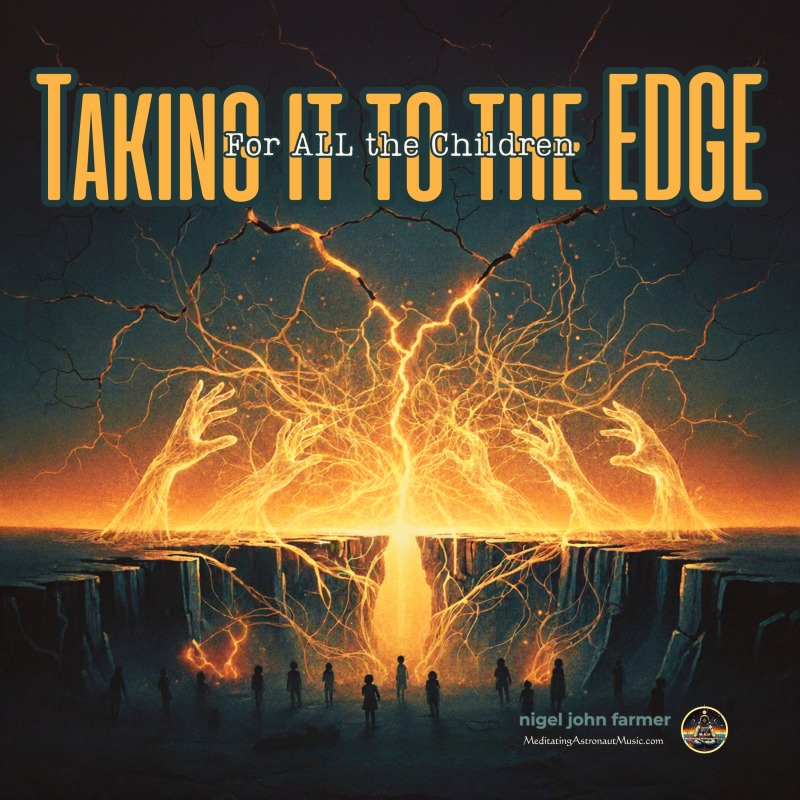
Two hundred and fifty years. In the grand sweep of geological time, that is nothing: a whisper, a single frame in a film running for four and a half billion years. Yet in that eyeblink, humanity has managed to conduct the most consequential, most reckless, and most undemocratic experiment in the history of life on Earth. We have turned up the thermostat on the only planet we have.
The Canadian astrophysicist Hubert Reeves, a man who spent a lifetime contemplating the cosmos, once framed our situation with characteristic precision: "L'homme est la seule espèce qui soit en train de détruire sa propre maison." Man is the only species in the process of destroying its own home. Not a rival species. Not an asteroid. Us. Deliberately, incrementally, and with full knowledge of what we are doing.
“Man is the only species in the process of destroying its own home.”
— Hubert Reeves, astrophysicist
The numbers that underpin this observation are staggering. In just the last 125 years, a fraction of a single human lineage, we have heated the planet faster than at any point in the preceding 125,000 years. The burning of fossil fuels, the levelling of forests, the industrial-scale rewriting of the atmosphere: these are not the side-effects of progress. They are the experiment itself. And we never asked permission to run it.
The Web That Holds Everything
If the temperature data alone were insufficient to concentrate the mind, there is a second set of numbers that ought to stop us cold. In just fifty years, a single human lifetime that many people alive today can personally remember, we have wiped out nearly 70 per cent of all monitored animal populations on Earth.
Read that again. Not 70 per cent of a species here or there. Seventy per cent of the monitored populations across the full sweep of wild vertebrate life. The polar bears and tigers get the headlines, but this is far larger and far more intimate than charismatic megafauna. This is the insects that pollinate the crops that feed us. The fish in the oceans. The birds whose disappearance from our gardens we barely notice until, one spring, the silence is simply too loud to ignore.
An ecosystem is not a collection of species sitting tidily in separate compartments. It is a web, impossibly intricate, fashioned over geological time, where the loss of one strand weakens the tension across a dozen others. Cut enough strands and the whole structure does not gently sag. It collapses. Often suddenly. Often irreversibly. Often before we have even understood what we had.
97 Per Cent Is Not a Margin of Error
The astrophysicist Neil deGrasse Tyson has a gift for reducing the abstract to the viscerally human. On the matter of scientific consensus, he offered an analogy that deserves to be pinned to the wall of every parliament on Earth. If a doctor told you that you had a 97 per cent chance of dying if you took a particular pill, you would not take the pill. You would not demand a second opinion from a commentator on television. You would not fund a think-tank to dispute the pharmacology. You would put the pill down and walk away.
The scientific consensus that human activity is driving this ecological and climatic emergency is that pill. Over 97 per cent of actively publishing climate scientists agree on the diagnosis. The evidence is not contested in any serious scientific forum. It has been replicated, reviewed, and confirmed across every conceivable methodology. And yet, with a regularity that would be farcical if the stakes were not so catastrophic, we elect leaders who dispute it, fund institutions to cloud it, and treat the 3 per cent as though they represent a meaningful counter-argument.
We are ignoring the doctors and listening to the charlatans. We are handing the car keys to a blindfolded driver and calling it governance.
The Feeling of Immortality
How does a species of such demonstrable intelligence arrive at such a catastrophic failure of collective will? The answer, I suspect, lies not in stupidity but in a kind of dangerous enchantment. Call it the feeling of immortality. We live and act as though this life, this planet, is a temporary arrangement, a staging post before something else. The planet's health becomes, at some barely conscious level, someone else's problem in some barely conceivable future.
But there is no somewhere else. There is no staging post. As Reeves well understood, having spent his career mapping the universe's indifference to our existence, this fragile, improbable, extraordinarily complex web of life is not the backdrop to our story. It is the story. Every strand of it that we cut is a sentence we will never be able to re-read.
The Red Cap and the Crown
And then there is the man in the red baseball cap.
It is worth pausing on that cap for a moment, because it is not an accident. It is a crown in populist disguise, worn by a man who has built an entire political identity on the proposition that the greatest threats to ordinary Americans are not a destabilised climate, not collapsing biodiversity, not the long-term poisoning of the air and water their children will inherit. The greatest threats, he insists, are the scientists, the institutions, the international agreements, and the inconvenient data that stand between his supporters and a return to something they are told was once great.
That something, in practical terms, is coal. Beautiful, clean coal, as he has called it with the confidence of a man who has never worked a shift underground in his life. While the last 125 years of temperature data accumulate in every serious scientific archive on the planet, his audiences are fed a different story: that the regulations protecting their rivers are job-killing bureaucracy, that the Paris Agreement was a globalist conspiracy, that climate science is an elaborate hoax perpetrated against the American worker.
They are not stupid, these audiences. They are unwitting. There is a profound difference. What they are being fed is not merely misinformation. It is a carefully constructed grammar of political control, and its phrases have been engineered to feel like common sense precisely because they are anything but.
"The Phrase" - The Concealed Concept - Why It Works
"Make America Great Again"
Palingenesis: national rebirth through mythic past
Appeals to nostalgia rather than announcing radical change
"Draining the Swamp"
Purge of the state apparatus
Sounds like anti-corruption rather than a seizure of power
"Enemy Within" / "Vermin"
Dehumanisation of dissent
Frames fellow citizens as existential threats to national survival
"America First"
Ultranationalism and withdrawal from international law
Sounds like common-sense patriotism rather than deliberate isolationism!
Political scientists have a word for this grammar: palingenesis, the myth of national rebirth through the purging of corrupting forces. It is not a new word. It was used to describe the intellectual architecture of European fascism in the 1930s, and it is being used again now for a reason. The red cap is the updated iconography. The rallies are the updated theatre. The targets have changed names, but the mechanism is identical: identify an enemy within, promise a purified future, and ensure that the genuine long-term threats to your supporters' lives, including the slow destruction of the biosphere their grandchildren will inherit, never make it to the top of the agenda.
This is why climate denial is not a policy disagreement. It is a political instrument. A population preoccupied with immigrants, with deep-state conspiracies, with swamps and vermin and enemies within, is a population that is not looking at the temperature data. It is not watching the insect populations collapse. It is not asking why the coal that was supposed to come back has not come back, and why the communities that were promised renewal are still waiting.
They are, without knowing it, cheering for the acceleration of the very experiment that is destroying the future of their own family lineage. That is not stupidity. That is the most sophisticated and most cynical political trick of the age.
“We only move when the margin’s thin.”
— Taking It to the Edge, Nigel John Farmer
And yet. There is a thought that discomforts me, and I offer it not as an absolution of the man but as an observation about the strange mechanics of historical change.
Consider what has happened since the red cap arrived. Europe, for the first time in a generation, is rethinking its dependency on American security guarantees and acting on it. Nations that had grown comfortable inside the assumption of a stable, rules-based international order are rediscovering the urgency of self-reliance, of collective European defence, of building institutions that do not require Washington's approval to function. Canada, Australia, and countries across the Global South are quietly but unmistakably diversifying their alliances. The world is not waiting any more.
This is the provocateur's paradox. Chaos, applied with sufficient force, compels movement in people and institutions that had become too comfortable to move voluntarily. The margin gets thin enough, and suddenly the things that could not be agreed upon for decades are agreed upon in months. We only move, as the lyric puts it, when the margin is thin. Trump has made the margin extraordinarily thin.
This does not make him a visionary. It almost certainly does not make him aware of the function he is serving. And this, I confess, is precisely what I find most compelling about the possibility. Because if he knew, if this were a calculated act of creative destruction undertaken with full philosophical clarity, he would be something far more dangerous than he already is. The man who stumbles into catalysis is merely the instrument of a moment. The man who plans it is a different order of threat entirely.
What we are more likely watching is a figure of colossal will and negligible self-awareness, sustained by the conviction that his own survival and the nation's greatness are the same project. The hatred directed at him is immense. The weight of global contempt that attaches to a single human being of his profile must be, on some level, crushing. And yet he continues. Whether that continuation is evidence of extraordinary inner fortitude, or simply of a temperament so thoroughly armoured by ego that no external signal can penetrate, is a question I suspect only history will settle.
What we should not do, in our very understandable fury at what he represents, is forget the deeper lesson. Trump is a symptom, not a cause. He is the figure that a broken system produced because a broken system needed to produce something that could no longer be ignored. The climate data was ignored. The biodiversity collapse was ignored. The slow hollowing-out of communities promised a future that never arrived was ignored. We ignored all of it, for long enough, and the margin got thin enough, and now here we are.
The crucifixion he is conducting upon himself, knowingly or not, is forcing a reckoning. The question is whether the reckoning will be large enough, and arrive quickly enough, to matter for the web of life that Hubert Reeves spent his extraordinary career urging us not to destroy.
The Smokescreen That Thinks for Itself
There is one further distraction worth naming, and it is perhaps the most seductive of all precisely because it is genuinely extraordinary. Artificial intelligence has arrived in the public consciousness at exactly the moment when the public's attention is most urgently needed elsewhere. Whether by design or by the indifferent timing of technological development, it has become the great conversation-consuming spectacle of the age: the thing that everyone is debating, fearing, celebrating, and legislating around while the temperature continues its quiet, relentless climb.
Let us be clear about what artificial intelligence actually is, because the confusion serves those who benefit from the distraction. AI is not evil. It is not conscious. It is not a malevolent force assembling itself in server rooms with intentions of its own. It is a tool, the most powerful cognitive tool that human beings have yet constructed, and like every tool in history from fire to the printing press to the splitting of the atom, its moral character is entirely determined by the hands that hold it and the purposes to which those hands put it.
A hammer is not violent. A person who uses a hammer to cause harm is violent. The distinction matters enormously, because collapsing it allows the wrong conversations to dominate. When we talk about AI as though it were an autonomous agent with its own agenda, we absolve the human beings who are making the real decisions: about which problems AI is directed to solve, whose interests it is built to serve, and whose future it is designed to optimise.
Applied with wisdom and genuine intent, AI could be one of the most powerful instruments we have ever possessed for addressing the ecological emergency. It can model climate systems at a resolution and speed no human team could match. It can optimise energy grids, accelerate materials science, identify deforestation in real time from satellite data, and help redesign the supply chains that are currently the hidden engines of the experiment we never voted to run. The tool is extraordinary. The question, as it has always been, is whether the people holding it are looking in the right direction.
At present, the loudest conversations about AI concern its threat to jobs, its potential for generating misinformation, its capacity to concentrate power in the hands of a very small number of very large technology companies, and, in the more apocalyptic register, its theoretical capacity to one day outrun human control altogether. These are not trivial concerns. But they are concerns about a technology that is decades or more from its most dramatic hypothetical consequences, while the ecological crisis is not hypothetical and is not decades away. It is here. It is measurable. It is already irreversible in significant part.
We should be clear-eyed about the risk that the AI debate, in its current form, is functioning as another distraction: the newest and shiniest object in a long series of objects placed between the public's gaze and the data that most urgently requires their attention. This is not a conspiracy. It does not need to be. It only requires that the people who benefit from our collective inattention continue to benefit, and that the rest of us continue to find the spectacle of the new more compelling than the urgency of the existing.
The tool is not the problem. We are the problem. We have always been the problem. And we remain, despite everything, the only possible solution. Only Humaity's Hand can Turn the Key...
We have the data. We have had the warning for decades. We have, in the most perverse and unintended of ways, even acquired the catalyst. We now stand at the threshold of tools powerful enough to help us correct the course, if we choose to use them for that purpose. What we appear to lack, still, is the collective will to believe in our bones rather than merely in our heads that this life, this intricate, irreplaceable, unrepeatable web, is not a resource to be liquidated. It is everything.
The experiment is still running. The results are already in. The provocateur has forced the question into the open, the tool is in our hands, and the margin has never been thinner. The only question left is whether we have the courage to finally act as though we mean it.
Nigel John Farmer
© 2023~2024~2025~2026 MeditatingAstronaut.com - All Rights Reserved Worldwide
website by Meditating Astronaut Publishing