
The Instruction Set ~ Why Distance is a Relic of Classical Physics
From the flight deck, the most jarring realisation is not the size of the Earth. It is the total absence of "stuff." We are trained to think of the universe as a collection of billiard balls knocking into each other, but the higher you go, the more that model fails.
SPIRITUAL AWARENESS MINDFULNESS - SOUND
Nigel John Farmer
1/24/20263 min read
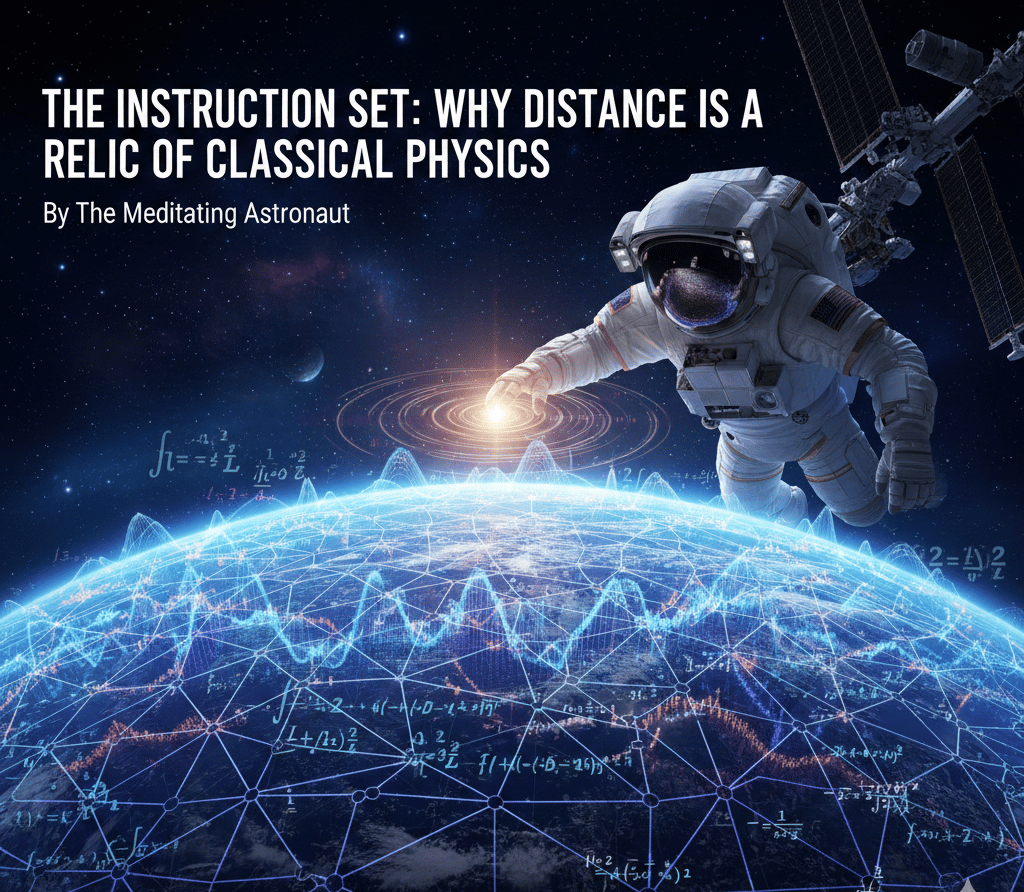
In advanced field physics, the universe is not made of objects. It is made of fields. A "particle" is just a localised vibration in a field, similar to a knot in a string. When we talk about energy, we usually imagine movement, which is a thing travelling from point A to point B. This is a nineteenth-century view that does not hold up to modern scrutiny. In a field-based reality, nothing moves. The field simply updates.
1. From Transport to Reconfiguration
In classical mechanics, if I want to affect you from here, I must send a photon or a wave. That takes time and crosses distance. In Quantum Field Theory (QFT), however, the field is already there. It is a continuous fabric.
As physicist Art Hobson notes in his work, There are no particles, there are only fields, the "particle" is merely the field’s way of resolving its energy locally. When a system changes, it is not "sending" a message. It is a global reconfiguration. Think of it as a standing instruction set. The universe does not calculate where every molecule goes. Instead, it resolves the Lagrangian, which is the mathematical function describing the state of a system, across all points simultaneously. The field updates to find its lowest energy state or equilibrium.
2. The Path Integral: Nature’s Resolution
To understand why "nothing moves," we must look at Richard Feynman’s Path Integral Formulation. In classical physics, an object takes one path. In the field, a particle is actually exploring every possible path between two points simultaneously.
The "movement" we see is simply the result of all those infinite possibilities interfering with one another. The paths that do not fit the "instruction set" cancel each other out, while the most efficient path remains. This is known as the Principle of Least Action.
The universe is not "choosing" a direction. It is a massive calculation where the field settles into the state of least resistance. It is not travel; it is a mathematical click into place.
3. The Observer as a Boundary Condition
This brings us to the "Double Slit" and the "Observer." In the lab, we say the observer "determines" the outcome. In field physics, we say the observer sets a boundary condition.
When you are not measuring the particle, the field is fluid. It exists as a probability wave defined by the Schrödinger Equation. The moment you measure it, you introduce a new coordinate into the instruction set. You are not "choosing" the path with your mind. Your interaction acts as a physical constraint that forces the field to resolve into a single, localised point.
Physicist John Wheeler famously stated that we are not observers but participants. By interacting with the grid, you change the rules of how the grid can vibrate.
4. The Astronaut’s Strategy: Tuning the Field
If energy is primarily pattern resolution, then distance becomes secondary. This reframes everything from communication to human intention.
The Classical Approach: Pushing against objects. This is distance-dependent, high-friction, and inefficient. It relies on Newtonian Force.
The Field Approach: Setting conditions. This is about Phase Transitions. Think of a room full of water vapour. You can try to catch every molecule and move it into a crystal by force, or you can simply drop the temperature. When the condition is met, the entire field resolves into ice instantly.
Summary for the Orbital Mind
Those who stop pushing and start setting conditions understand that they are part of the grid. If you want to change the "pattern" of your life or your work, you do not travel towards it. You change the local instruction set of your own field. You adjust your resonance, your focus, and your standing instructions.
The rest of the field, which is the reality you inhabit, has no choice but to resolve itself to match those new conditions.
Nigel John Farmer
References and Citations
Farmer, N. J. (2024). The Interconnected Universe: A Unified Theory of Thought, Consciousness, and Reality..
Farmer posits that thought acts as an active, non-material energy that drives the formation of time and space.
His "Mind in Essence" framework describes the alignment of heart, brain, and soul as the mechanism for interacting with the universal field.
The theory suggests that reality is a "universal web" where patterns are perceived through implicit learning within the conscious field.
Feynman, R. P. (1948). Space-Time Approach to Non-Relativistic Quantum Mechanics. Reviews of Modern Physics, 20(2), 367–387. https://doi.org/10.1103/RevModPhys.20.367
Hobson, A. (2013). There are no particles, there are only fields. American Journal of Physics, 81(3), 211–223. https://doi.org/10.1119/1.4789885
Wheeler, J. A. (1983). Quantum Theory and Measurement. Princeton University Press. (Section on the "Participatory Universe").
Schrödinger, E. (1926). An Undulatory Theory of the Mechanics of Atoms and Molecules. The Physical Review, 28(6), 1049–1070. https://doi.org/10.1103/PhysRev.28.1049

© 2023~2024~2025~2026 MeditatingAstronaut.com - All Rights Reserved Worldwide
website by Meditating Astronaut Publishing